


How to read Windguru for kitesurfing beginners
How to read Windguru for kitesurfing beginners https://freeridetarifa.com/wp-content/uploads/2025/12/How-to-read-windguru-beginner-tips-freeridetarifa.jpg 600 600 Freeride Tarifa https://freeridetarifa.com/wp-content/uploads/2025/12/How-to-read-windguru-beginner-tips-freeridetarifa.jpgIf you’re new to kitesurfing in Tarifa, you’ll quickly hear two things: “Tarifa is windy… all the time” and “Check Windguru before you go”.
But when you open Windguru for the first time, it can feel overwhelming: numbers, arrows, colours, knots, gusts.
This guide breaks everything down step by step, so you know when it’s a good day to kite — and when it’s better to wait or book a lesson.
Why wind is so important for kitesurfing in Tarifa
Tarifa sits between the Atlantic Ocean and the Mediterranean Sea, creating a natural wind tunnel through the Strait of Gibraltar. That’s why Tarifa is known as the wind capital of Europe. For kitesurfers, this means:
- More rideable days
- Consistent conditions
- An amazing learning environment
What is Windguru?
Windguru is an online wind and weather forecast platform specifically designed for wind sports like kitesurfing, windsurfing and sailing. Unlike regular weather apps, Windguru focuses on the things kiters actually care about:
- How strong the wind will be
- Where the wind will come from
- How stable or gusty it will be
- When conditions will improve or die
- How big are the waves
- How cloudy and rainy it will be
Understanding wind speed
Wind speed on Windguru is measured in knots (kt). To keep it simple: 1 knot ≈ 1.85 km/h
For learning kitesurfing in Tarifa:
- 12–14 kt → Light but rideable with bigger kites
- 14–25 kt → Ideal learning conditions
- 25–35 kt → Strong, only with instructor supervision
- 35+ kt → Too strong for beginners ⚠️
Gusts are sudden increases in wind speed that happen over short periods of time. While the average wind might feel steady, gusts are the moments when the wind suddenly hits harder. On Windguru, gusts show you how stable or unstable the wind is.
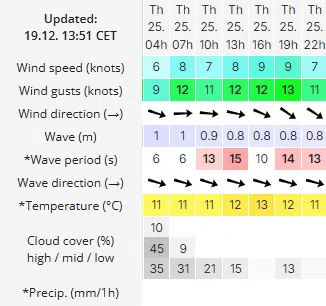
Example 1: Smooth Wind
Average wind: 9 knots
Gusts: 12 knots
This means that most of the time the wind is blowing around 9 knots, and only occasionally it increases slightly to 12 knots.
On the water, this feels:
Smooth and steady
Easy to control
Predictable for your kite
This is light wind so technical for beginners.
Example 2: Gusty Wind
Average wind: 20 knots.
Gusts: 30 knots.
Most of the time the wind is 20 knots, but it can suddenly spike to 30 knots. On the water, the kite pulls harder and unpredictably, making it harder, more tiring, and less safe for beginners. This is really gusty wind — can be difficult for beginners.
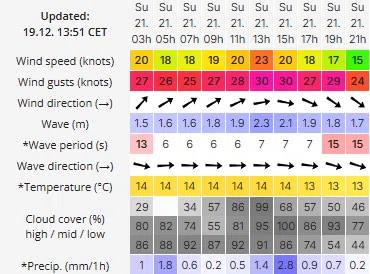
The “Rule of Thumb”: If the gust speed is more than 50% higher than the steady wind (e.g., 10 kts steady / 20 kts gusts), expect a very difficult session with a lot of “lulls” (dead spots) and “bullets” (sudden hits).
Watch the Colors: If the steady wind is a calm Green (14 kts) but the gust row is a bright Orange or Red (25 kts), don’t be fooled by the green; the wind will feel much more aggressive than the “average” suggests.
Cloud Cover: Check the cloud rows at the bottom. If you see high percentages of Low Clouds, the wind is often more turbulent and gusty because the clouds interfere with smooth airflow.
Understanding wind direction specific to Tarifa
Understanding wind direction is key to kitesurfing safely in Tarifa. But not only, cause those wind direction are also associated to local effects. See bellow the two main winds you need to know:
Levante is a strong easterly wind blowing from the Mediterranean Sea toward the Atlantic Ocean across the Strait of Gibraltar. (In Windguru: arrow pointing to the left). In Tarifa we have what we call a venturi effect. Windguru is showing the wind speed but doesn’t include those extra knots of wind created by the venturi.
- Strong and powerful 💨
- Often offshore, blowing away from the beach
- Can be gusty and unpredictable near the shore
- Warm air
Poniente is a westerly wind, blowing from the Atlantic Ocean toward the Mediterranean Sea. (In Windguru: arrow pointing to the right). When having this wind you also need to check the size of the waves and their direction. Also this wind works with thermal effect, so clouds cover have again a big impact.
- Side-onshore, blowing slightly toward the beach 🌊
- Cooler, fresher air
- Smooth and more stable wind
- Predictable conditions
Poniente can be the best wind for beginners learning kitesurfing in Tarifa when there is not too much waves. It is “Side-Onshore,” meaning it pushes you back to the beach if something goes wrong.
Tip: You’re a beginner riding independently since a very short time and never kitesurfing yet in Tarifa?! Beginners should take an advanced class to understand the tricky wind that Levante can be, before going by themselves— it can be challenging even for experienced riders.
In wind forecasting for spots like Tarifa, these two effects are the “secret ingredients” that make the real-life wind much stronger than what the general computer models predict.
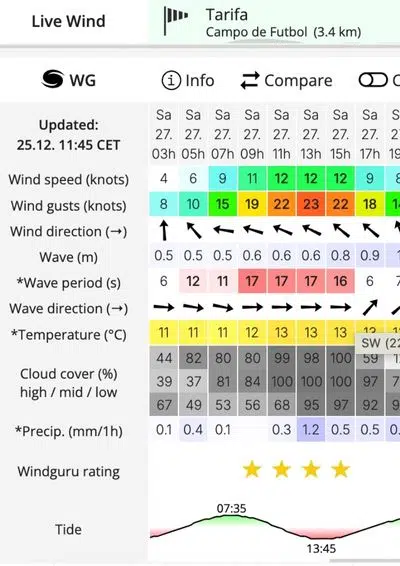
Venturi Effect (The Funnel)
It’s a physical principle where wind speeds up as it is squeezed through a narrow gap. In Tarifa: The Strait of Gibraltar is a narrow “bottleneck” between the mountains of Spain and the mountains of Africa. When the Levante (East wind) blows, it is squeezed into this 14km-wide gap. This “compresses” the air, causing the wind speed to jump—More or less adding 10knots to what you can read on Windguru.
Thermal Effect (The Vacuum)
It is a local wind created by temperature differences between the land and the sea. In Tarifa this is most common with the Poniente (West wind). If Windguru says there is only 8 knots of wind, but it’s a scorching hot afternoon, the rising heat from the valley behind Tarifa acts like a vacuum. It “sucks” the Poniente in from the Atlantic, often doubling the wind speed (e.g., from 8 knots to 12-15 knots) in the afternoon.
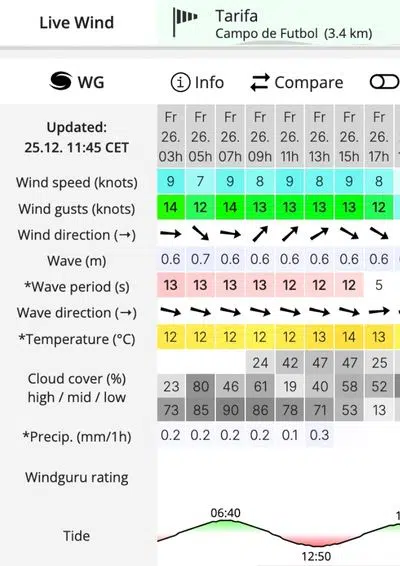
Best Wind Conditions for Beginner Kitesurfers in Tarifa
The ideal setup looks like this:
- Wind speed: 15–25 knots
- Direction: Poniente (W) or smooth Levante (SE)
- Gusts: Low and steady
- Weather: Clear and dry
- Spot: Wide, sandy beaches like Los Lances
Tarifa secret rows on Windguru
To truly read Tarifa like a local, look at these three things to enjoy the best conditions.
- Wind speed: WRF 3km or 9km models are usually more accurate for Tarifa because it “sees” the mountains that cause the gusts.
- Cloud Cover: If you see “0% Cloud Cover” and “25°C” in Tarifa with a light West wind, don’t stay home—the thermal effect will likely make it a perfect kiting day!
- Temperature: From May to September, if it’s hot and the forecast shows a weak 8-knot Poniente, a Thermal Effect often kicks in at Valdevaqueros or Los Lances, boosting it to 15+ knots for an afternoon session.
- Smooth Levante: If you see light wind 8-knot Levante, (Wind South East) don’t stay home… The Venturi Effect will boost the wind to 15+ knots for a really nice session.
When you arrive at the beach and nobody or only 2 to 3 kite are kitesurfing…. Maybe it is because it is not the good time to go. Tarifa kite spots are always with a minimum of 20 kites, so wait before to go and getting in a bad situation.
Learn to Read the Wind Like a Real Kiter
At Freeride Tarifa, we don’t just teach you how to ride — we teach you how to understand the wind. 👉 Book your kitesurf lesson in Tarifa and learn when to rig, when to wait, and when it’s game on 🤙 🌊